

The third century represents a very troublesome time period for the Roman Empire. Furthermore, in many ways, this period differs greatly from the earlier periods of the Roman Empire since its establishment. The late Empire has torn apart due to an internal struggle for power between various self-proclaimed rulers and due to external threats from numerous (so-called) barbarian peoples. The stability of the Empire was greatly diminished, especially during the period of the Crisis of the Third Century which lasted approximately 235 to 284 AD. The great crisis started with the death of Severus Alexander, the last of the Severian’s . This event marked the end of the dynasties which ruled since August. Anarchy spread quickly and military generals from all over the Empire started declaring themselves rulers. They fought each other until only one remained. Further destabilization of the Empire was caused due to the abovementioned. During this period, 30 self-proclaimed emperors were present and almost all of them were accepted by the Senate. The collapse of the entire system was almost imminent. The imperial crisis was put to an end in 284 AD by an emperor whose rise to power completely changed the Empire and the course of European history in general.
His imperial name was Gaius Aurelius Valerius Diocletianus Augustus – Diocletian. As far as it is known, he was a lowborn named Diocles before his rise to power. Historians tend to say that he might have been a son of a shepherd or perhaps even a son of an ex-slave, however, literary sources vary a lot on that subject. What the sources do agree on is that he was born somewhere in Roman Dalmatia, in present-day Croatia. It is not possible to pinpoint exactly in which part of Dalmatia he was born, however, most commonly, it is believed that it occurred somewhere within the immediate vicinity of the metropolis of Salonae. No real evidence which supports the abovementioned claim exists other than the fact that he built a great palace near the city, where he retired and most likely died, thus leading the historians to believe he was in some way connected to the aforementioned area. Others speculated he might have been from Dioclea, another city in Roman Dalmatia which is situated in today’s Montenegro. However, this connection relies solely on the similarity of the names Diocles and his pre-imperial name Diocles.
Interestingly enough, local legends and oral tradition about him remained centuries after his death. The legends, which retold the life and deeds of the Roman emperor Diocletian, were transmitted orally mostly in areas around the ruins of ancient Salonae. Don Frane Bulić, one of the first and greatest Croatian archaeologists, carried out extensive research in the 19th century. He was intrigued by the fact that uneducated and illiterate people, which lived near the ancient ruins of Salonae, actually possessed knowledge about this Roman emperor. Furthermore, it turned out they knew many stories about him, his wife, daughter, palace, and prosecution of Christians. Frane Bulić was fascinated with these stories and by the fact that people from that area could even point to the very house Diocletian was born in (today’s village of Kučine). That this area is his birthplace rests upon the sole fact that these people had an extensive oral tradition on the Emperor which served as evidence to Frane Bulić. The abovementioned is very similar to Heinrich Schliemann’s discovery that the 19th-century people of Ithaca knew the stories of Odysseus and his journey. Nevertheless, these people never read a book in their lives and even if they wanted to, they were not able to read for the most part. Oral tradition should not be discarded easily, but truth be told, there is just not enough hard evidence to support the claims of Frane Bulić or the exact location of Diocletian’s birthplace. In conclusion, we can only be somewhat certain in the following: he was from Dalmatia and he was lowborn since many of the contemporary and later sources all agree on it. On top of that, the presence of his retirement palace in the area further strengthens the claim. Furthermore, he was not a native-born Roman, as many emperors of the time were not, considering they were proclaimed by the greatly barbarized army which chose the ruler amongst themselves.
Diocletian started his military career as a common soldier probably serving under the emperor Galien. He most likely served in Gaul or Moesia and eventually became a personal guard of the emperor Carinus or perhaps even the commander of the guard. This suggests he was an able soldier and a very ambitious man. He occupied this position when emperor Carinus gathered an army to campaign in Persia in 284 AD. Soon after the death of Carinus’s brother and co-ruler Numerian, Diocletian was proclaimed emperor by the soldiers. The real historical facts on the topic are shrouded greatly by an interesting legend. The legend states that Diocletian was a young soldier who encountered a druidess while serving in Gaul. She told him he would kill a faithful boar and become an emperor afterward. According to the story, consequently, Diocletian spent a lot of time hunting for the faithful boar but could never find one. The opportunity came up after the death of Numerian in Persia. Numerian was killed by Aper (the name means boar). Consequently, Diocletian was proclaimed emperor by his soldiers and Aper was condemned for murder. Aper was executed in front of the army and thus the killing of the faithful boar (Aper), i.e. the prophecy, was fulfilled.
Of course, little is known about the authenticity of this legend, i.e. if it remotely depicts real events. It is a known fact that Diocletian was the Illyrian emperor who was indeed proclaimed by the army in 284 AD and that he became pretendant. That was a very common practice during the Crisis of the Third Century. Armies would proclaim rulers as they wished and killed them in the same manner. Being an emperor was a fatal job. Diocletian was accepted by the Senate soon after he defeated emperor Carinus. He became the sole emperor in 285 AD. Emperors before him were not able to hold power for a length of time, however, Diocletian ruled until 305 AD and during the period he managed to stabilize the Empire and prolong its existence.
Diocletian was aware of the succession ways in the Roman Empire and by what means he came to power. He might have seen this as one of the biggest problems in the Empire. He was certainly rather dedicated to fixing the problem and delivering internal peace. The Empire was simply too massive to manage its subjects promptly. Diocletian introduced a way of fixing this problem. In 286 AD, he took Maximian as his co-emperor, and in 293 AD, he introduced two other co-emperors; thus, creating a new system of government – the tetrarchy, rule of four. The first two emperors were considered senior, in this case, Diocletian and Maximian, and the second two emperors were considered junior. Each senior emperor would choose his own junior emperor which would eventually succeed him and become a senior. In that way, junior emperors succeed senior titles and were able to choose new junior emperors. The rule of the Empire was primarily split into two parts: between two senior emperors. In this case, Diocletian decided to rule the eastern part of the Empire from Nicomedia (today’s Izmir in Turkey) while Maximian decided to rule the western part from Mediolanum (today’s Milano in Italy). It is important to note that Diocletian remained superior to Maximian. Diocletian chose Galerius, a Dacian, as his junior emperor and appointed him to rule over Illyricum. Maximian, respectively, chose Constantius Chlorus, an Illyrian, as his junior and he gave him rule over Gaul. In this way, Diocletian constructed rule over the Empire and brought internal stability for as long as he was in power.
Two things should be emphasized; firstly, nobody was ruling from Rome which was already a common practice during this century. A large majority were not even native Romans, just like Diocletian. They belonged to “barbarian peoples” which lived inside the Empire and served in the Roman army. Therefore, it is not hard to conclude why Rome was not chosen as its capital. Diocletian decided to rule over the eastern part of the Empire since it was traditionally the richest and most populated part. Many would have taken rule over it if they had the chance. Secondly, the appointment of Constantine Chlorus as a junior emperor to Maximian was of great importance. Constantine Chlorus eventually became senior emperor by means of tetrarchy in 305 AD, but he died a year later and the army declared his son, Constantine the Great, the emperor. Meaning, he came to power due to Diocletian’s new system of rule.
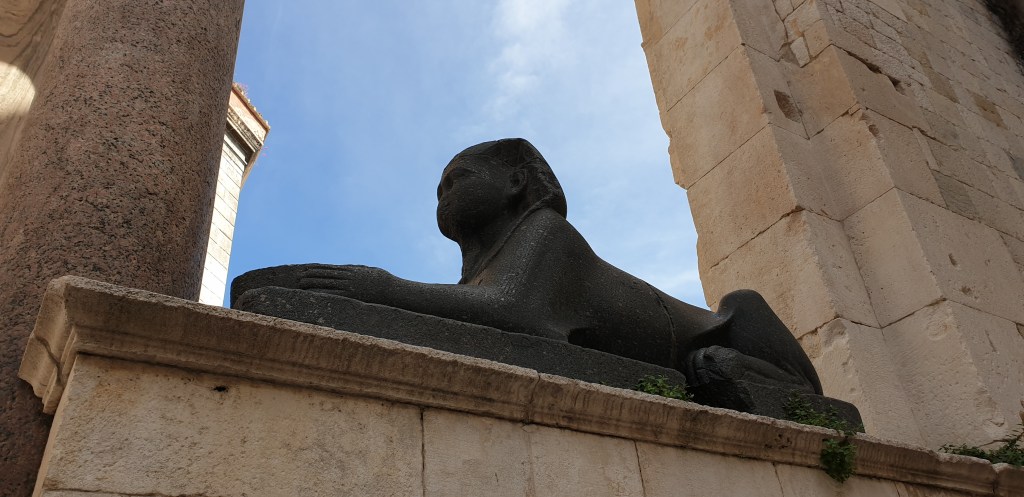
Internal peace was somewhat achieved, however, the Empire was still in danger. Diocletian and his co-emperors had to deal with wars against Germans, Sarmatians, Franks, Goths, and Persians, but also rebellions in Egypt and Mauretania and usurpers in Gaul and Britannia. This might be one of the reasons why Diocletian reorganized the army and abandoned the old military system. It is known he added more legions; nevertheless, it is unclear whether he shrank them in size. He additionally fortified parts of the borders that reached “troublesome peoples”. The reformed army system further stabilized the Empire, but it required significant funds. It led to reforming the finance and tax system of the Empire, which had debatable success. During the Diocletian period, the provinces also saw a major overhaul. They were cut down to smaller sizes and thus the total number of provinces was increased. This was done for the purpose of reducing the strength of provincial governors and in order to discourage them from rebelling. In conclusion, Diocletian was aware that the Empire needed some serious reforms which had to be carried out in order to save the Empire and stay in power. The reforms certainly worked to some extent and prolonged the existence of a collapsing empire. However, it was all in vain after Diocletian’s death. There was another great and maybe even more lasting change that took place during the Diocletian period. It is important to note that Roman emperors never held the title emperor as we tend to call them. Their official title was princeps and thus the real government system in the Empire was called the principate. It meant that the emperor is the first among equals in the Senate, and his position still needed to be approved by the Senate. Technically, the Roman Empire was still a republic in that system and the emperor was a person chosen by the people. The reality was different, but nominally that was the case. In the 3rd century AD, emperors started to abandon the title of princeps and introduced the title dominus et deus – master and god. Diocletian had the time to fully implement the usage of the new title. The practice of looking upon the ruler as a divine being probably infiltrated into the Roman society from the Orient. This was a more monarchist approach to government which the Romans promptly avoided. Diocletian himself ruled from the eastern side of the Empire and was in contact with such traditions which he certainly found useful for his new system of government. Emperor got the divine status from Diocletian’s period onwards. People had to bow as low as they could and avoid direct eye contact. That sealed the emperor’s position as a monarch who was adorned in purple and worshiped by the people. Interestingly enough, this practice rooted itself deep into European traditions through the Middle Ages. Proof of Diocletian trying to present himself as divinity can be seen in the well-preserved remains of his retirement palace in Split, Croatia. He brought granite Egyptian sphinxes that were placed in front of his mausoleum in a pharaoh manner. The mausoleum itself was the largest structure in the entire complex, towering over others, marking his resting place as the most important building.
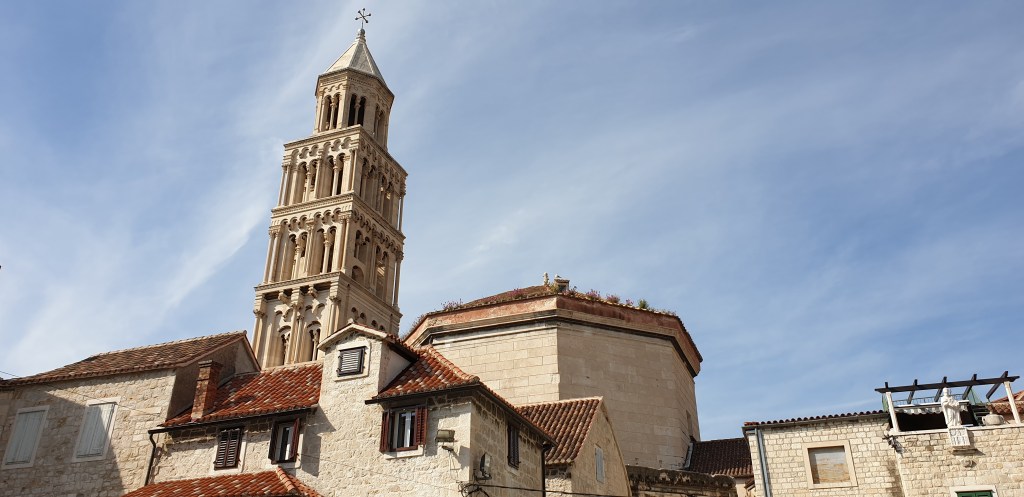
Historians know Diocletian mostly for tetrarchy and the reforms he implemented in the Empire, but for the most part of history, he was remembered as a great persecutor of Christians. The memory of him was preserved through medieval times as a negative character and an enemy to early Christianity. The legends and stories that remain mentioned earlier, describe him as a vile character who made his Christian wife and daughter worship the pagan gods and who threw Christians to wild animals in the arena. Whether his wife and daughter really were Christians or historical facts were largely distorted to support the Christian rhetoric, remains disputed; however, the latter is more likely to be true. The truth is he indeed was one of the greatest persecutors of Christians, but also the last one. Just one year after he ended his rule, Constantine the Great took power. From that time, Christianity began its rise as the primary European religion. It is no wonder that Christians that settled in the Diocletian’s retirement palace in Split, centuries after his death, destroyed every single piece of evidence of him. No statue or mention of his name remained. They threw out his bones from the mausoleum and turned it into the cathedral. Furthermore, they dedicated it in the name of the martyr that apparently died during his reign.
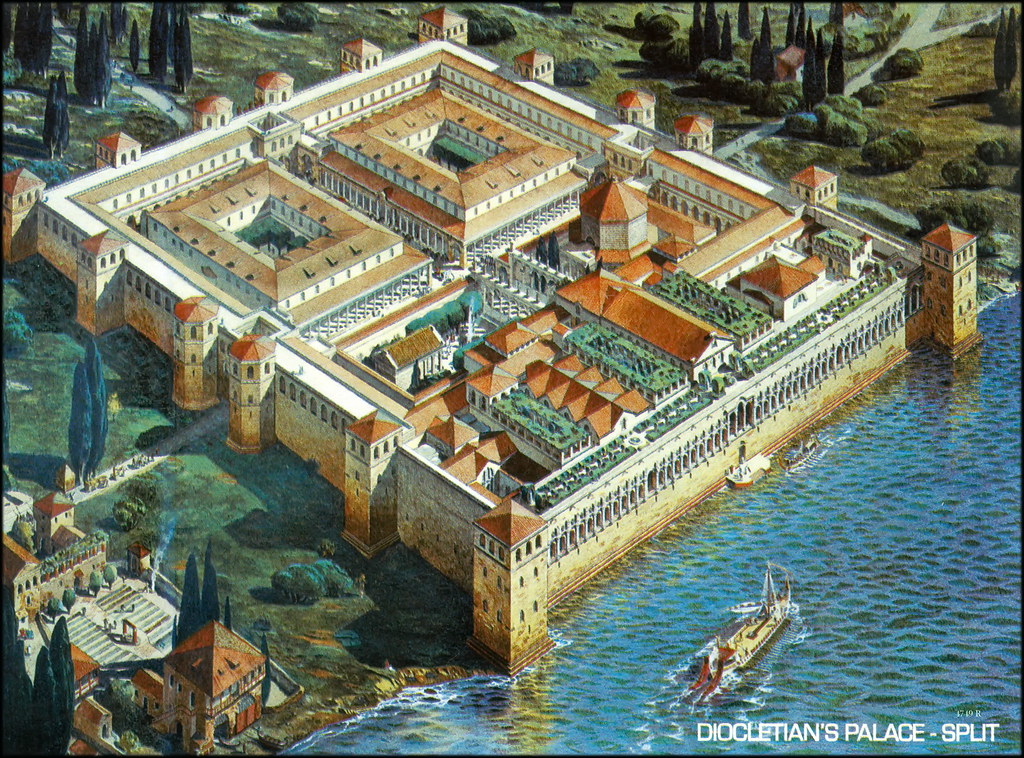
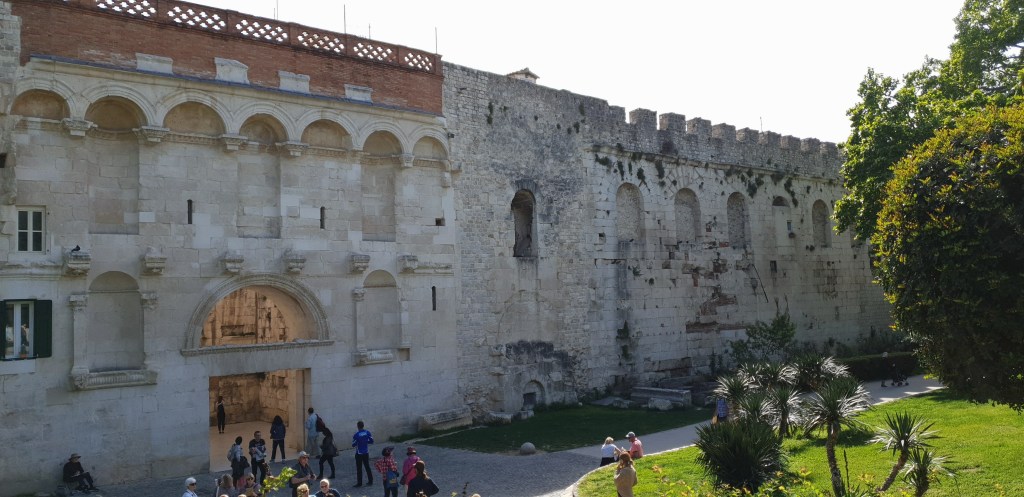
After 21 years of rule, Diocletian did something rarely seen in the Roman Empire – he abdicated. He gave up his rule in his old days and forced the other senior emperor Maximian to give up power. Following the rules of the tetrarchy, the junior emperors thus became senior and took new junior as subordinates. What exactly was the reason for his abdication, nobody can really say for certain? Some speculate it was due to his illness, others say he imagined the tetrarchy to work in such a way that seniors would eventually give up rule together at the same time. What we do know for certain is that he prepared a magnificent palace near the city of Salonae in Roman Dalmatia, where he most likely retreated after abdication. It took 10 years to build the palace and which was finished probably in 305 AD. The palace resembled a military camp more than a villa due to the huge walls and towers surrounding it. Remarkably, three centuries after his death high walls of the palace were of the great purpose to the fleeing Christian population of the destroyed city of Salonae (razed by barbarians in the 7th century AD). They took refuge and founded the city of Split which stands to this day as the largest city on the east Adriatic coast. The remains of the palace are beautifully preserved and integrated into the lives of many generations that lived there after Diocletian.
Diocletian most likely spent his last days there and was forced to watch the destruction of everything he had built. As soon as he abdicated, the new tetrarchs started fighting each other which resulted in a civil war. His wife and daughter most likely never joined him there, as many stories say, but were rather killed as soon as Diocletian was no longer in power. We know he remained somewhat relevant in the Empire due to a contemporary source claiming he was invited to a council whose aim was to settle the matters of the new civil war, but he promptly rejected to participate. It was even written that he replied: “If you only knew what kind of beautiful cabbage I am growing in my palace, you would never invite me to leave it behind”. We do not know if that quote was really spoken, however it remained as a part of the stories revolving around Diocletian. His death is also shrouded in mystery. Some sources say he was assassinated in the palace, while some say he died of illness and others say he died of sadness. The truth is that we will never know the circumstances regarding his death.
The palace at Nicomedia, from which Diocletian ruled, was not researched and excavated thoroughly. Certainly, this research would offer significant new evidence about his life. Fortunately, the remains of his retirement palace still stand today whose Roman walls form the core of the city of Split. Even though the Emperor never thought it will become a city, history played it that way and Diocletian remained and still is in the memories of its residents. For historians, Diocletian was a great reformer and a powerful emperor, but for people of Split and the surrounding areas he was always the founder of their city, and legends that surround him are stories of unique origin.

 DiocleSpot